
Added Sugar vs. Total Sugar: How to Read the Difference
Understand added sugar vs. total sugar, why the numbers should not be added together, and how to compare yogurt, drinks, and other packaged foods.

Quick answer
Total sugar includes all sugars in a serving, both naturally occurring and added. Added sugar is the portion introduced through processing or sweetening, including sources such as sugar, honey, and syrups. On a US label, “includes added sugars” means that amount is already part of total sugars. Do not add the two numbers together; compare equivalent serving sizes.
Key takeaways
- Added sugars are a subset of total sugars.
- No added sugar does not mean sugar-free or carbohydrate-free.
- Honey and syrups still count in added-sugar context.
- Consider serving size, fiber, protein, and the food's role—not sugar alone.
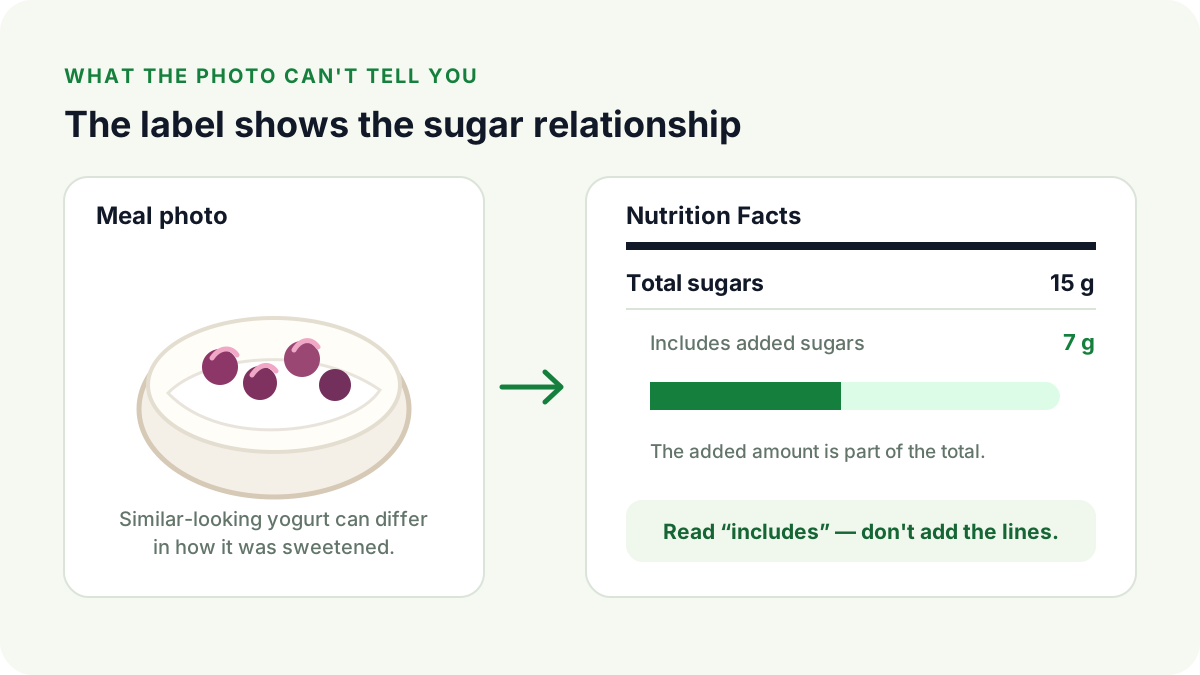
- 15 g totalAll sugars in the example serving.
- Includes 7 g addedAlready counted within the 15 grams.
- 8 g remainingNaturally occurring sugars in this example.
- Not 22 gAdding total and added would double-count.
The added sugar vs. total sugar distinction becomes much simpler once you notice one word on a US Nutrition Facts label: “includes.” Added sugars are included within total sugars, not listed as an extra amount to add on top.
That does not mean the two lines are redundant. They answer different questions about the same serving. Total sugars describes the overall amount of sugars, while added sugars provides context about sweeteners introduced into the food.
What does total sugar mean?
Total sugars includes naturally occurring sugars and added sugars in a serving. Milk contains lactose, fruit contains naturally occurring sugars, and a sweetened yogurt may contain both milk sugar and an added sweetener.
The number does not tell you whether the food also provides fiber, protein, calcium, or other nutrients. A single sugar total cannot make whole fruit, milk, and a sweetened soft drink nutritionally equivalent.
It also does not represent total carbohydrate. Starches and fiber are other carbohydrate components. A product with little sugar can still contain a substantial amount of carbohydrate, which matters when following an individualized carbohydrate plan.
What counts as added sugar?
The FDA includes sugars added during processing, foods packaged as sweeteners, sugars from honey and syrups, and certain concentrated fruit or vegetable juices used in this context. Naturally occurring sugars in milk, fruits, and vegetables are treated differently.
“Natural” is therefore not the opposite of “added.” Honey added to yogurt is still a sweetener. Maple syrup added to oatmeal contributes added sugars even if its ingredient list is short.
Special presentation rules apply to single-ingredient sugars and syrups so the label does not imply that an additional sugar was mixed into pure honey. The underlying contribution is not erased by that labeling exception.
Read the numbers without double-counting
The FDA uses a yogurt example with 15 grams of total sugars, including 7 grams of added sugars. The remaining 8 grams are naturally occurring sugars. The total is 15 grams, not 22.
| Line in the FDA example | Meaning |
|---|---|
| Total sugars: 15 g | All sugars in the serving |
| Includes added sugars: 7 g | Part of those 15 grams came from added sources |
| Naturally occurring sugars: 8 g | Calculated difference in this example |
The arithmetic is specific to that sample. Do not apply it to every yogurt. Products differ in serving size, milk composition, fruit content, and sweetening.
For the full reading sequence, start with our Nutrition Facts guide. Serving size should come before interpreting any nutrient total.
What does the added-sugar percent Daily Value mean?
The FDA’s labeling reference Daily Value for added sugars is 50 grams on a 2,000-calorie daily basis. A serving with 7 grams of added sugar therefore contributes 14% DV in the FDA example.
That reference helps interpret labels. It is not a personalized instruction to consume 50 grams, and the 2,000-calorie basis is not everybody’s energy requirement.
The FDA’s general label guide considers 5% DV or less low and 20% DV or more high per serving. Total sugars has no established Daily Value on the US label, so the two sugar lines are not presented in exactly the same way.
Why compare equivalent amounts?
Imagine comparing two yogurts where one container is larger. Its higher per-container sugar number might partly reflect the amount, not just the formulation. Read serving sizes and decide whether you are comparing equal portions or the containers you actually plan to eat.
Both comparisons can be useful, but they answer different questions. Equal amounts help compare products; your actual portion helps describe consumption. Do not switch between them halfway through a comparison.
The same issue appears with drinks. A bottle may contain more than one serving, and your usual cup may be larger than the label’s reference. Account for the amount you consume before interpreting the total.
Look beyond the front-of-package phrase
“No added sugar” does not mean sugar-free, calorie-free, or automatically the most suitable choice for you. Naturally occurring sugars and other carbohydrates may remain. Other ingredients may also affect flavor, texture, and nutrition.
Conversely, the presence of some added sugar does not tell you everything about a food. A product may still provide nutrients and fit into an overall eating pattern. Compare the full label rather than reducing the decision to one badge.
For another useful lens, read food processing levels explained. A processing category and an added-sugar amount are different kinds of information; neither can reliably stand in for the other.
Fruit, juice, and the importance of food structure
Whole fruit generally brings water, fiber, and other components alongside its naturally occurring sugars. A beverage may provide a different eating experience and nutrient profile even when some sugar amounts look similar.
Harvard’s Nutrition Source emphasizes carbohydrate quality rather than treating all carbohydrate-rich foods alike. This supports looking at the food package around the sugar, not simply choosing the lowest number.
Our article on nutrient density versus calorie density explains why energy and nutrient contribution need separate attention. Neither sweetness nor a sugar line alone can summarize food quality.
Can a scanner tell the difference?
A photo of a meal generally cannot reveal whether a sweetener was added. Plain and sweetened yogurt can look nearly identical. A label photo provides stronger evidence, provided the values and serving information are readable.
MeasureFood offers label scanning and nutrition insights. After scanning, compare the extracted total-sugar and added-sugar lines with the printed panel, especially if small text or glare made the image difficult.
You can try a label scan in MeasureFood, then verify that the app has not confused a decimal point, a unit, or the serving amount. Technology is useful when it assists the distinction rather than hiding it.
A practical shopping routine
Choose a food you buy regularly, such as yogurt, cereal, or a drink. First check how much you usually consume. Then compare added sugars on an equivalent basis, along with the nutrients and ingredients relevant to that food.
If a less-sweet version is appealing and affordable, it may be an easy change. If not, consider a different portion or pairing without treating the food as a moral failure. Taste, access, cultural preference, and the full eating pattern matter.
People following a clinical nutrition plan should use their prescribed approach, particularly for carbohydrate management. Added sugar is not the only carbohydrate that can be relevant to medical decisions.
Remember the relationship
Total sugars is the whole amount; added sugars is part of it. Keep that relationship clear, check the serving, and use the rest of the label to understand the food.
Keep the original package as your reference and avoid letting one nutrient number replace the bigger picture.
Frequently asked questions
Does no added sugar mean no sugar?
No. A product can contain naturally occurring sugars without added sweeteners. It may also contain starch or other carbohydrates.
Does honey count as added sugar?
Yes in the FDA's added-sugar framework. Single-ingredient honey and syrup labels have special presentation rules, but natural origin does not remove their added-sugar contribution.
Can a photo tell whether yogurt has added sugar?
Not reliably. Plain and sweetened yogurt can look similar. Use the product's nutrition panel and ingredient list.
References
This article is general education, not medical advice. MeasureFood values are estimates. Read our editorial policy.


