
Nutrient Density vs. Calorie Density: Why Both Matter
Understand nutrient density vs. calorie density, why nutritious foods can be energy-dense, and how to make practical meal comparisons without food guilt.

Quick answer
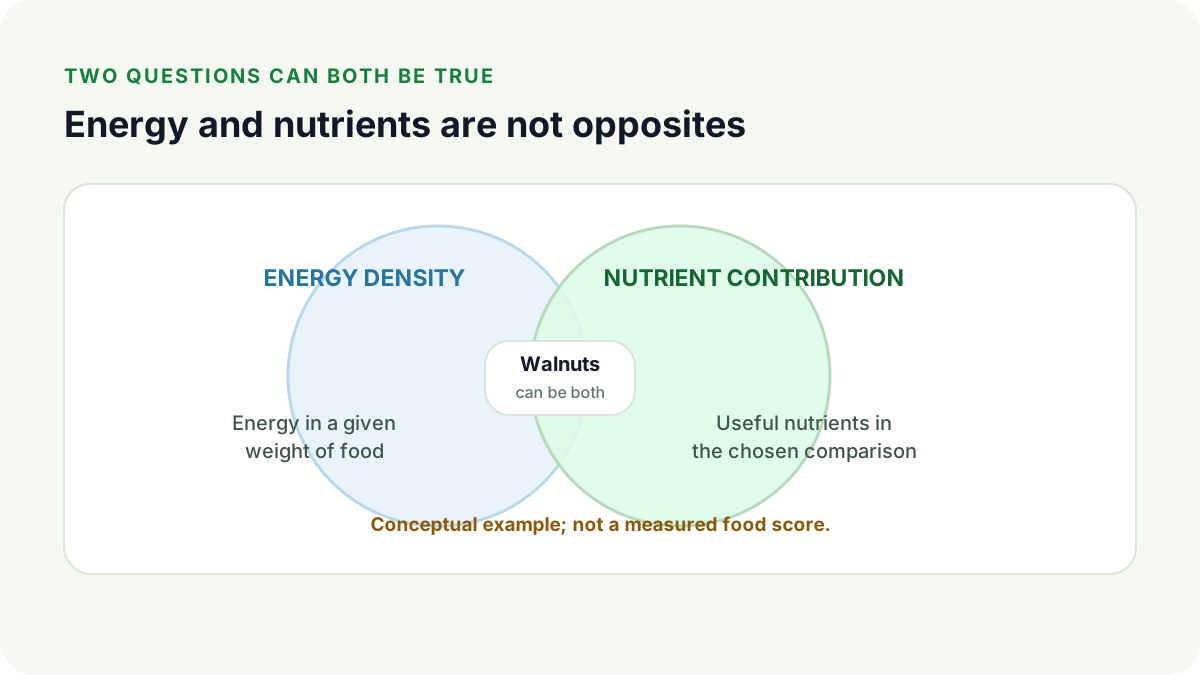
Calorie density describes how much energy a food provides for a given weight. Nutrient density describes its useful nutrient contribution relative to an amount of food or energy, depending on the definition. The two are not opposites: nuts can be energy-dense and nutrient-rich. Evaluate portions, food variety, and your needs instead of assuming fewer calories always means better nutrition.
Key takeaways
- Low-calorie and nutrient-rich are not synonyms.
- Energy-dense foods can contribute useful nutrients.
- Processing, calories, and nutrients are three distinct lenses.
- Balanced meals matter more than a universal good-or-bad food score.
- EnergyHow many calories are in this amount?
- NutrientsWhat useful nutrients does it contribute?
- ProcessingHow was it made, and what was added?
- Your mealHow does it fit your needs and eating pattern?
The nutrient density vs. calorie density distinction helps explain why “low calorie” is not a complete nutrition strategy. A food can contain relatively little energy but contribute few useful nutrients, while another can provide substantial energy along with valuable nutrients.
You do not need a complicated scoring system to use the distinction. Ask two separate questions: How much energy does this amount provide, and what else does it contribute? The answers can help you build meals without labeling foods as universally good or bad.
What is calorie density?
Calorie density, also called energy density, describes the energy in a given weight of food. It is often expressed as calories per gram. Foods containing more water generally have lower energy density, while foods rich in fat often have higher energy density.
This is a concentration concept, not a recommended portion. A small amount of an energy-dense ingredient may contribute meaningful calories; a large amount of a lower-density food may still contribute substantial energy.
Preparation changes the picture. Adding water to soup increases its weight without adding energy. Adding oil contributes energy with relatively little volume. Drying fruit removes water, concentrating energy by weight compared with the fresh fruit.
What is nutrient density?
Nutrient density concerns the contribution of useful nutrients relative to an amount of food or energy. Definitions and scoring methods vary, so the phrase does not identify one universal official number.
Depending on the comparison, people may consider protein, fiber, vitamins, minerals, or beneficial fats. Some scoring methods also account for nutrients to limit. Always ask what the specific measure includes rather than assuming every “nutrient score” means the same thing.
For ordinary meals, the practical version is straightforward: notice whether foods contribute a range of useful nutrients and whether the overall pattern is varied and adequate.
Why the two are not opposites
Nuts, seeds, avocado, and certain oils can be energy-dense while contributing useful fats or other nutrients. Their calorie concentration does not erase those contributions. Portion context remains relevant, but avoidance is not the only conclusion.
Vegetables and many fruits often provide water, fiber, and micronutrients with comparatively lower energy density. That can make them useful meal components, but it does not mean a meal made only of low-energy foods is adequate for every person.
| Food example | Energy-density context | Nutrient context |
|---|---|---|
| Walnuts | Concentrated energy in a small portion | Fats, protein, fiber, and other nutrients |
| Leafy vegetables | High water content, relatively low energy | Micronutrients and some fiber |
| Lentils | Preparation and water content matter | Protein, fiber, and micronutrients |
| Sweetened beverage | Depends on recipe and amount | Often fewer useful nutrients than a balanced meal |
These are qualitative examples, not measured nutrient comparisons for a particular product. Use labels or a matching composition entry when you need actual values.
Compare foods on a meaningful basis
Comparing calories per serving can mislead if the servings differ greatly. Comparing per 100 grams puts energy concentration on the same weight basis, while comparing your actual portion answers a consumption question.
Neither method is always superior. If you are choosing a snack, the portion you intend to eat matters. If you are trying to understand why dried fruit looks small relative to fresh fruit, a weight-based comparison may explain the concentration.
Read nutrition labels step by step to keep serving size and nutrient interpretation aligned. Do not compare the largest printed numbers without checking what amounts they represent.
Think about the whole meal
A salad can combine low-energy-density vegetables with energy-dense dressing, nuts, cheese, or avocado. That is not inherently a problem; those ingredients can contribute flavor, satisfaction, and nutrients.
The useful question is whether the combination fits your needs. Is there a protein source? Is the portion adequate? Are there fiber-rich ingredients? Does the meal leave you satisfied enough to support your day?
Likewise, a bowl of plain rice provides energy, but adding beans, vegetables, and a source of healthy fat changes the nutrient profile and variety. “More complete” is often a more useful goal than “fewer calories.”
Do macros capture nutrient density?
Protein, carbohydrate, and fat are important, but their totals do not describe everything about a food. Two meals with similar macro amounts can differ in fiber, sodium, vitamins, minerals, and food variety.
Harvard’s Nutrition Source describes the protein “package”: foods bring other components alongside protein. That is why equal protein grams do not automatically make two foods nutritionally interchangeable.
Our beginner’s guide to tracking macros explains how to use macro numbers without overlooking quality. Treat tracking as one view of a meal, not a complete assessment of healthfulness.
Where does processing fit?
Processing is another separate question. It describes how foods are made and formulated, rather than their energy concentration or nutrient contribution alone. Some minimally processed foods are energy-dense; some processed foods can contribute useful nutrients.
The NOVA framework organizes foods into four groups, but those groups are not calorie categories. Read food processing levels explained for the classification and its limitations.
Keeping the concepts separate prevents oversimplification. A product cannot be judged entirely from its packaging, a calorie total, or one nutrient badge. Ingredients, portions, and dietary pattern all supply context.
Can a photo scanner assess the difference?
MeasureFood offers calorie and macro estimates together with food-quality insights and an app-specific S–E grade. This can encourage you to look beyond energy alone.
However, a photograph cannot reveal every nutrient or hidden ingredient. A simple-looking sauce may contain more oil or sugar than is visually apparent, and an ingredient’s micronutrient content is not directly visible.
You can explore your meal’s nutrition with MeasureFood, then ask separate questions about energy, nutrient contribution, and processing. The grade is a prompt for interpretation, not a universal or government-endorsed nutrient-density measure.
Make practical changes without rigid rules
Start with a meal you eat often. Consider adding vegetables, fruit, beans, or whole grains where they make sense. Check whether a suitable protein source and enough overall food are present.
If a concentrated ingredient is easy to overestimate or overlook, learn your usual portion rather than automatically removing it. Enjoyment and satisfaction matter for a routine you can maintain.
For people with increased energy needs or difficulty eating enough, energy-dense nutrient-rich foods can be particularly useful. People with medical conditions may need different priorities. General advice to always minimize calories is therefore inappropriate.
Use both ideas, keep the context
Calories describe energy; nutrients describe contribution. Neither tells the whole story independently, and processing adds another lens rather than a final verdict.
Build a varied, adequate pattern that fits your circumstances. Use labels, recipes, and professional guidance when needed, rather than letting a single score decide what belongs on your plate.
Frequently asked questions
Are nuts unhealthy because they are calorie-dense?
No. Nuts provide fats, protein, fiber, and other nutrients. Their energy concentration makes portion context useful, not the food inherently unhealthy.
Is nutrient density a single standardized score?
No. Different approaches emphasize different nutrients and reference amounts. Check what a particular score includes and excludes.
Should everyone choose the lowest-calorie foods?
No. People have different energy needs, and adequate nourishment matters. Those with increased needs may benefit from nutrient-rich energy-dense foods.
References
This article is general education, not medical advice. MeasureFood values are estimates. Read our editorial policy.


