
How to Read Nutrition Labels, One Step at a Time
Learn how to read nutrition labels by checking serving size, calories, percent Daily Value, added sugars, and ingredients before comparing products.

Quick answer
To read a US Nutrition Facts label, check the serving size and servings per container first. Adjust calories and nutrients for the amount you will eat, then use percent Daily Value to interpret nutrients. Five percent DV or less is low; 20% or more is high. Read added sugars separately from total sugars and use the ingredient list for additional context.
Key takeaways
- The listed serving is not a personal intake recommendation.
- Calories and nutrients must match the portion you consume.
- The 5% and 20% DV guide helps compare nutrients.
- Nutrition Facts and the ingredient list answer different questions.
- ServingFind the reference amount and package servings.
- Your portionScale calories and nutrients to what you eat.
- Daily Value5% or less is low; 20% or more is high.
- IngredientsAdd recipe context that the numbers do not show.
Learning how to read nutrition labels is less about memorizing every nutrient and more about asking questions in the right order. The calories on the front of a package may catch your attention, but they are only meaningful when you know the amount they describe.
This guide focuses on the US Nutrition Facts label. Readers in the UK, Canada, Australia, and elsewhere should check local labeling conventions, especially whether information is presented per serving, per package, or per 100 grams.
Step 1: Find the serving information
Look for both the serving size and the number of servings per container. A package may contain several servings even when it is easy to finish in one sitting. The printed nutrient values usually apply to the serving shown.
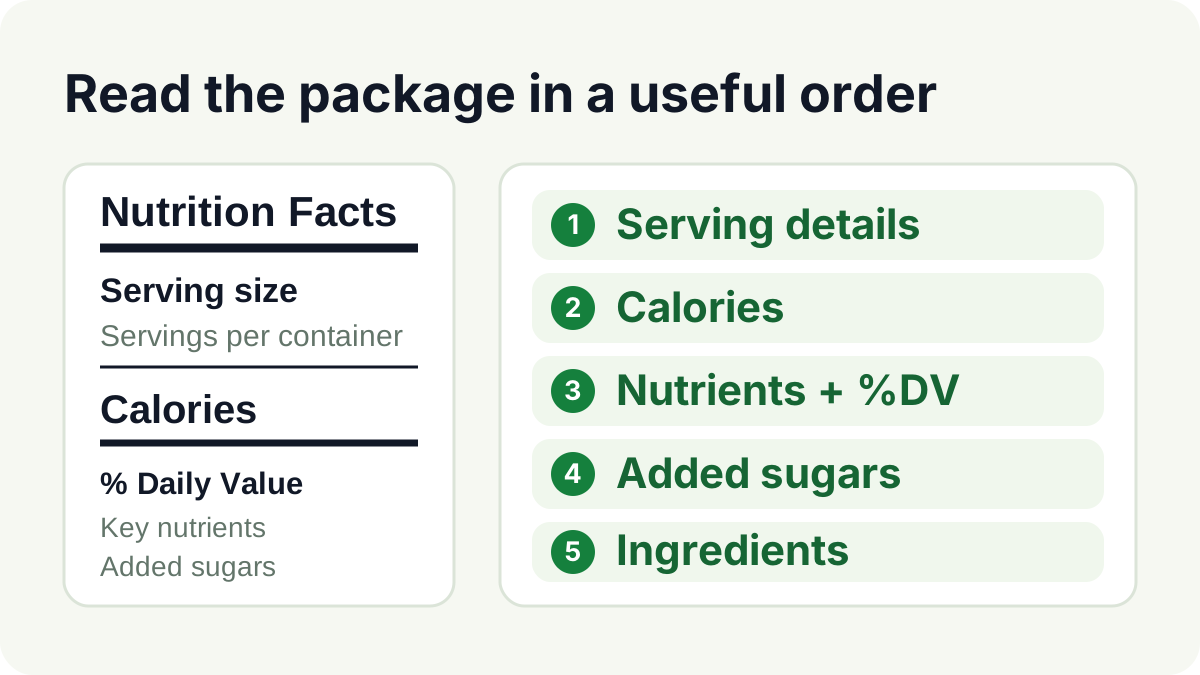
The FDA explains that serving sizes reflect amounts people typically consume. They are not recommendations for how much you personally should eat. Treat the serving as a reference unit, then connect it with your actual portion.
For example, if a label gives values for one cup and you eat two cups, you have consumed two labeled servings. The calories and listed nutrients need to be doubled. The same logic applies to half a serving.
Step 2: Calculate the amount you will actually eat
Before comparing products, put them on an equivalent basis. One cereal may use a larger labeled serving than another. Comparing their per-serving numbers without noticing that difference can give a misleading impression.
Use this simple calculation:
Amount consumed ÷ labeled serving amount = number of servings consumed.
Then multiply the per-serving calories and nutrients by that number. Keep the units consistent: grams with grams, cups with cups, or clearly counted pieces with the corresponding labeled pieces.
A worked FDA example
The FDA’s sample lasagna label lists 280 calories and 15 grams of protein per one-cup serving. Two cups therefore provide 560 calories and 30 grams of protein. These figures describe that educational sample label, not every lasagna.
| Amount of sample lasagna | Calories | Protein |
|---|---|---|
| One cup / one serving | 280 | 15 g |
| Two cups / two servings | 560 | 30 g |
The calculation is straightforward; selecting the correct reference is the important part. Check whether a product’s label describes food as packaged or after preparation with additional ingredients.
Step 3: Use calories as energy information
Calories describe the energy supplied by a serving. They do not, by themselves, tell you whether a food provides fiber, useful fats, protein, vitamins, or minerals.
The 2,000-calorie figure used for general labeling advice is not a personalized target. Your needs can differ. Avoid treating the number printed in a label footnote as an instruction to eat that amount.
For a fuller explanation of energy versus nutrition, read nutrient density and calorie density. A food can be relatively energy-dense and still contribute useful nutrients.
Step 4: Interpret percent Daily Value
Percent Daily Value, or %DV, shows how much a nutrient in one serving contributes to a daily reference amount. It helps put different nutrient quantities on a comparable scale without requiring you to memorize each reference in grams or milligrams.
The FDA’s general guide is:
- 5% DV or less: low in that nutrient per serving.
- 20% DV or more: high in that nutrient per serving.
“High” is not automatically good or bad. A high fiber contribution means something different from a high sodium contribution. The FDA generally encourages more fiber and certain micronutrients, while limiting saturated fat, sodium, and added sugars.
Do not add the %DV column vertically. Each percentage refers to a different nutrient and its own daily reference. Also remember to adjust for the number of servings you consume.
Step 5: Distinguish total sugars from added sugars
Total sugars include both naturally occurring sugars and added sugars. The “includes added sugars” line identifies a subset of the total; it is not an extra amount to add on top.
A yogurt can contain naturally occurring milk sugar as well as added sweeteners. That does not mean the total sugar number tells you the entire nutritional story. Protein, calcium, serving size, and the overall pattern still matter.
Our guide to added sugar versus total sugar walks through the arithmetic and common misunderstandings. It also explains why honey and syrups are not exempt from added-sugar context simply because they sound natural.
Step 6: Read the ingredient list
Nutrition Facts tells you amounts of listed nutrients. The ingredient list tells you more about what the product contains. Use both, particularly when comparing products that look similar from the front of the package.
An ingredient name you do not recognize is not enough to declare a food unsafe. Likewise, a short list does not automatically make a food suitable for every dietary need. Allergies and medical restrictions require direct checks, not a general health score.
If you are interested in processing, the ingredient list can offer context that nutrient totals cannot. See our explanation of food processing levels and NOVA rather than assuming every packaged food is ultra-processed.
Step 7: Compare products you would actually use
Compare similar foods in equivalent amounts, then consider how you eat them. A lower-sodium soup can be useful if soup is a regular meal component. A higher-protein yogurt may be relevant if you need a more substantial breakfast.
Look for meaningful differences instead of declaring one product perfect. Price, availability, taste, cultural preference, preparation time, and the rest of the meal also influence whether a choice is practical.
A single nutrient should not erase the bigger picture. Choosing a product only because it has the lowest calorie number can overlook fiber, protein, satisfaction, or how much of it you will actually eat.
Can a label scanner make this easier?
MeasureFood offers nutrition-label scanning alongside meal-photo analysis. That can help present printed nutrition information in a more approachable way, but scanned text and serving assumptions still need checking.
Use a clear image with the panel flat, readable, and in focus. Watch for glare, curved containers, tiny print, decimal points, and confused units. Compare the extracted values with the original package before relying on them.
You can try MeasureFood’s label workflow, then apply the same order: serving, your portion, nutrient interpretation, and ingredient context. A scanner should assist reading, not replace it.
Build a repeatable grocery habit
You do not need to analyze every product exhaustively. Start with foods you buy often and one question that matters to you, such as fiber at breakfast or sodium in a regular ready meal.
Read equivalent amounts, choose a practical option, and avoid turning food selection into a moral score. If you have a medical condition requiring specific limits, follow individualized advice rather than general label heuristics.
The core routine is short enough to reuse: establish the amount, interpret the nutrients, and check the context.
Frequently asked questions
Is 2,000 calories my recommended intake?
Not necessarily. It is a general labeling reference. Individual needs vary with factors such as age, body size, activity, and health.
Should I add total sugars and added sugars together?
No. Added sugars are already included in total sugars. Adding the two would double-count the added portion.
Can I compare a US label with a UK label directly?
Check the units and basis first. Many non-US labels use per-100-gram values and different reference conventions. Compare equivalent amounts, not simply the largest displayed numbers.
References
This article is general education, not medical advice. MeasureFood values are estimates. Read our editorial policy.


