
Food Processing Levels: The Four NOVA Groups Explained
Understand food processing levels, the four NOVA groups, and why processing, calories, and nutritional quality are related but different questions.

Quick answer
NOVA describes four food processing levels: unprocessed or minimally processed foods, processed culinary ingredients, processed foods, and ultra-processed foods. It considers the extent and purpose of industrial processing, not simply calorie content. Classification can require ingredient and manufacturing information. Use processing as one lens alongside nutrient content, portion size, affordability, and your overall eating pattern.
Key takeaways
- Freezing, cooking, and pasteurizing do not automatically make food ultra-processed.
- NOVA's four groups are not a calorie scale.
- Mixed dishes and ambiguous ingredients make classification harder.
- MeasureFood's S–E grade is not the same system as NOVA.
- Group 1Unprocessed or minimally processed foods.
- Group 2Processed culinary ingredients.
- Group 3Processed foods made with added culinary ingredients.
- Group 4Ultra-processed industrial formulations.
Food processing levels can help explain how foods are made, but the phrase is often used as though it were a simple health ranking. In reality, washing vegetables, freezing peas, pressing oil, baking bread, and manufacturing a snack all involve different kinds of processing.
The useful question is not “Has this food been touched by a process?” Nearly everything we eat has. Ask what kind of processing occurred, why it was used, what the food contains, and how it fits into the overall diet.
What is the NOVA classification?
NOVA is a system that groups foods by the extent and purpose of industrial processing. The US National Cancer Institute describes four groups, developed by researchers at the University of São Paulo and refined over time.
The groups are a way to study and describe diets. They are not measurements of calories, individual nutrient adequacy, or whether a particular food will produce a health outcome in a particular person.
Classification sometimes requires details beyond the product’s name. Ingredients and manufacturing context can distinguish products that appear similar on a shelf. A photo of a finished meal may not supply that information.
Group 1: Unprocessed or minimally processed foods
This group includes foods kept close to their original form, including foods altered through processes such as cleaning, chilling, freezing, drying, or pasteurization without the additions characteristic of other groups.
Examples can include fresh fruit, plain frozen vegetables, dry beans, oats, and plain milk. The exact product matters: plain frozen peas and peas prepared in a flavored sauce should not automatically be treated as the same item.
Minimal processing can improve food safety, storage, or convenience. Frozen vegetables are not nutritionally disqualified simply because they came from a freezer rather than a farmers’ market.
Group 2: Processed culinary ingredients
These are ingredients used to prepare and season foods, such as oils, sugar, and salt. They are commonly derived from foods or nature through processes that make them useful in cooking.
An ingredient’s group does not tell you how much to use. Olive oil and table sugar belong to a culinary context, but their nutritional contributions differ. Portion and the rest of the meal still matter.
This illustrates why processing cannot replace nutrition information. Two ingredients in the same broad group may play very different roles in a recipe.
Group 3: Processed foods
Processed foods are generally made by combining foods from the first group with culinary ingredients such as salt, sugar, or oil. Common examples can include vegetables preserved with salt and simple breads made from flour, water, yeast, and salt.
Products vary, so avoid classifying every bread, cheese, or canned item from its name alone. A simple formulation and a more complex industrial formulation may fall into different categories.
Convenient processed foods can be practical components of meals. Canned beans, for example, can make a weekday meal easier; look at the specific formulation and sodium information instead of treating the can as a warning sign.
Group 4: Ultra-processed foods
This group describes industrial formulations often containing substances derived from foods and ingredients used to shape flavor, texture, appearance, or convenience. Certain packaged snacks, soft drinks, and reconstituted products may fall here.
It is not simply “anything with a long ingredient list.” Ingredient count alone is a weak shortcut. Some long lists reflect spices or fortification, while a short list may still require manufacturing context.
| Question | Processing information helps? | Additional information needed |
|---|---|---|
| How was the food formulated? | Yes | Ingredients and manufacturing details |
| How much energy is in my portion? | Not by itself | Nutrition data and amount eaten |
| Does this fit my medical needs? | Not by itself | Individual clinical guidance |
| Does it contribute fiber or protein? | Not reliably alone | Nutrition Facts and food composition |
What does research say?
A 2019 NIH inpatient randomized crossover trial studied 20 adults who ate an ultra-processed diet and a minimally processed diet for two weeks each. Participants could eat as much or as little as they wanted.
The NIH reported that participants ate more energy and gained weight during the ultra-processed phase compared with the minimally processed phase. The trial provides stronger causal evidence for those study diets than an observational association alone.
Its limits matter: it was small, short, and tested complete dietary patterns under controlled conditions. It does not prove that every food assigned to a group has the same effect, or that a particular additive explains the result.
The researchers also recognized practical constraints, including cost, time, and access. Advice that ignores those constraints may be difficult to apply.
How should you use processing information?
Use it as an additional question rather than the only decision rule. Start with what you regularly eat and identify practical opportunities to include more minimally processed staples, if that fits your circumstances.
For example, you could pair a convenient prepared meal with vegetables, choose a plain base that you season yourself, or compare the fiber and sodium in products you already buy. Improvement does not require replacing every packaged food at once.
Read Nutrition Facts in context before concluding that a processing category answers everything. A label can reveal nutrient information that the classification does not provide.
Keep calories, nutrients, and processing separate
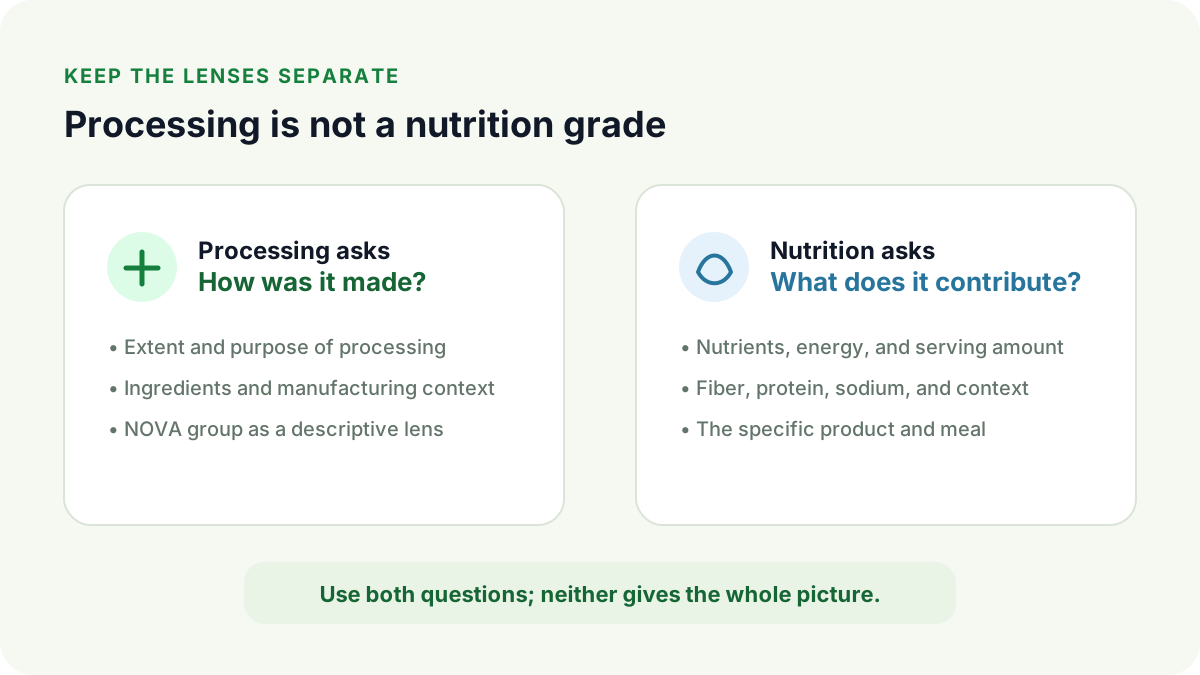
Energy density concerns calories relative to food amount. Nutrient density concerns the nutrients provided. Processing classification concerns how a food was produced. These concepts can overlap, but none is a direct substitute for another.
Our guide to nutrient density versus calorie density explains that distinction. For a specific label question, see added sugar versus total sugar rather than guessing sweetness or sugar content from processing alone.
This separation helps avoid two common mistakes: assuming all minimally processed foods are low in calories, and assuming all convenient foods contribute little nutrition.
Where do AI food grades fit?
MeasureFood provides food-quality and processing insights alongside calorie and macro estimates, including an app-specific S–E grade. That can prompt a closer look at a meal, but the grade is not an official NOVA category.
A food photo cannot reliably reveal every industrial ingredient or manufacturing step. A label scan may provide more context, yet interpretation still depends on what information is visible and how the system handles it.
You can explore a meal or label with MeasureFood, then compare its interpretation with the ingredient list. Treat the output as educational context, not a diagnosis or a declaration that a food is forbidden.
Make one useful change
Choose a repeat meal and ask whether one accessible change would improve variety, fiber, or satisfaction. Keep cost, culture, enjoyment, and preparation time part of that decision.
Understanding food processing levels should make decisions clearer, not make eating more fearful. Keep the full meal and your own circumstances in view.
Frequently asked questions
Are all packaged foods ultra-processed?
No. Plain frozen vegetables, oats, and many other packaged foods may be minimally processed. Packaging alone does not establish the NOVA group.
Does an ultra-processed classification prove a food is harmful?
No single classification determines an individual's outcome. Study design, overall dietary pattern, amount, and the specific food matter. Classification is not a diagnosis.
Is MeasureFood's S–E grade an official NOVA score?
No. It is an app-specific food-quality interpretation. NOVA uses four processing groups; an S–E grade should not be presented as an official NOVA or government certification.
References
This article is general education, not medical advice. MeasureFood values are estimates. Read our editorial policy.


