
Calorie Tracking Without Weighing Food: What Works
Make calorie tracking without weighing food more useful with labels, familiar portions, photo estimates, and a realistic routine for busy days.

Quick answer
Calorie tracking without weighing food works best when you use the strongest information available: matching labels, known recipe portions, familiar dishes, and careful photo estimates. Pay extra attention to oils, sauces, drinks, and large portions. The result will be less precise than a well-measured recipe, but it can still support general food awareness without requiring a scale at every meal.
Key takeaways
- Use labels and known portions before making visual guesses.
- Calibrate repeat meals instead of measuring everything forever.
- Give hidden fats, sauces, and drinks deliberate attention.
- Consistency is useful, but a consistent error is still an error.
- Matching labelAdjust for the amount you consumed.
- Known recipeUse the actual number of portions.
- Familiar servingCompare with a calibrated bowl or spoon.
- Visual estimateRecord uncertainty, especially for mixed meals.
Calorie tracking without weighing food is often the only realistic option at work, in restaurants, or when someone else cooks. Bringing out a kitchen scale at every meal is not necessary to learn something useful about your eating habits.
The trade-off is precision. Without measured amounts, you need reasonable references and an honest understanding of uncertainty. A low-effort routine can support awareness, but it should not pretend to deliver the same information as a fully measured recipe.
Start with the purpose, not a perfect number
Decide what you want to learn. Are drinks easy to overlook? Are portions larger on busy days? Do meals regularly lack a protein source? A calorie estimate may help answer some questions, but not every food decision needs a precise total.
If your goal involves protein, carbohydrate, and fat rather than energy alone, begin with our guide to tracking macros. It explains why numbers are only one part of understanding a meal.
For clinical restrictions or medication decisions, use the method your healthcare professional recommends. This article describes an everyday awareness routine, not a substitute for prescribed dietary measurement.
Use labels whenever they genuinely match
For packaged foods, the printed nutrition panel is usually more specific than a visual guess. Read the serving size, servings per container, and whether the food is described as sold or prepared.
If a package contains two servings and you eat the whole package, use two servings in your record. If the values refer to a dry mix, check whether milk, oil, or other preparation ingredients need to be included separately.
Avoid assuming “one package” and “one serving” mean the same thing. The FDA explains that serving size reflects typical consumption and is not a recommendation of how much you personally should eat.
Make repeat meals easier
Breakfasts and weekday lunches often repeat. Use that to your advantage. Establish a reasonable reference for the bowl, spoon, or food combination you regularly use, then reuse that reference when the meal is genuinely similar.
You might measure your usual cereal portion with a household cup once, note how full the bowl looks, and check the label against that amount. This does not make all future bowls identical, but it gives you a better starting point than an unexamined guess.
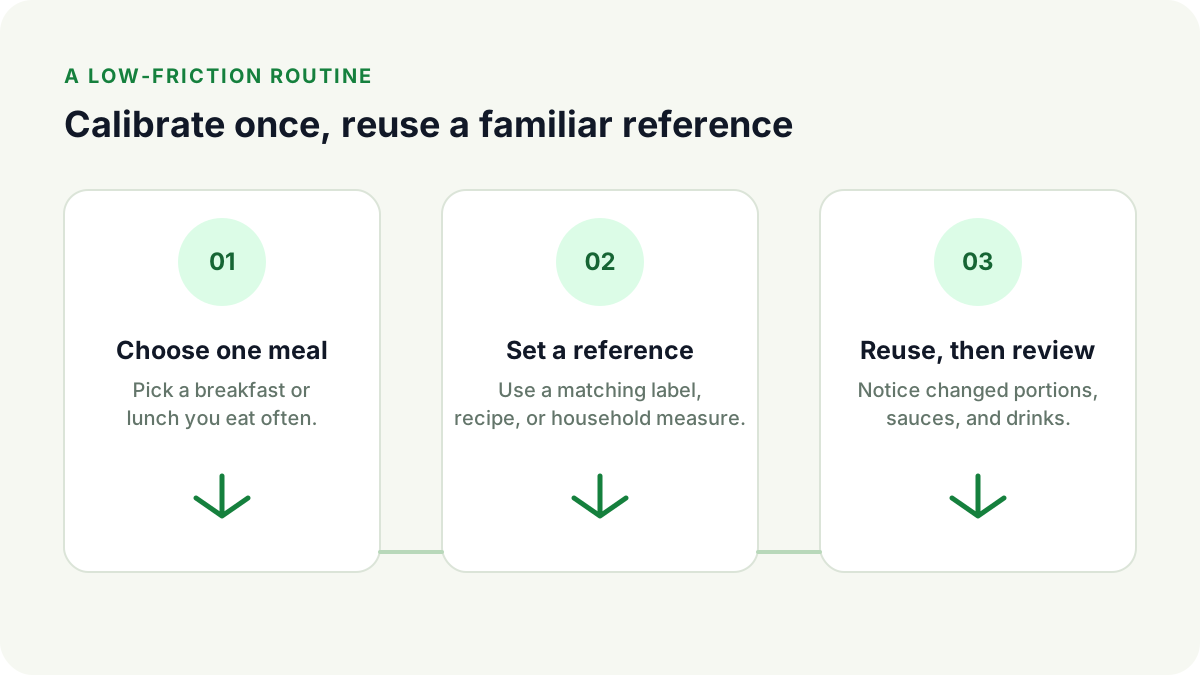
Do not reuse a reference when the ingredients have changed substantially. A plain sandwich and one with extra cheese, mayonnaise, and a larger bread roll are not equivalent just because both are called lunch.
Use household measures thoughtfully
Measuring cups and spoons can help when a recipe or label provides comparable units. They are less reliable when the food is packed differently, heaped above the rim, or cut into irregular pieces.
| Situation | Useful shortcut | Limitation |
|---|---|---|
| A familiar breakfast bowl | Calibrated fill level | Bowl depth and ingredient density vary |
| Packaged snack | Count pieces if label allows | Pieces may differ in size |
| Homemade pot of soup | Divide by actual portions | Ingredients may distribute unevenly |
| Restaurant rice serving | Compare with a known serving | Hidden depth and added fat remain uncertain |
Our guide to estimating portion sizes goes further into calibration. Avoid turning a rough hand reference into a supposedly exact gram conversion.
Give the biggest unknowns more attention
Not every ingredient contributes equally to uncertainty. Cooking oils, dressings, butter, nut spreads, cheese, and sweetened drinks can be easy to overlook. A small-looking quantity may matter because these foods can be concentrated sources of energy.
Ask what changed the meal most. Was the chicken breaded? Was the rice cooked in oil? Did the salad arrive already dressed? Did you finish the drink? Those questions are often more useful than arguing over a few pieces of leafy vegetables.
This is not a rule to avoid those ingredients. It is a reminder to include them when you want a meaningful estimate. Foods can contribute flavor, satisfaction, and nutrients even when they are energy-dense.
Build a simple photo-first routine
A photo can preserve the meal before you forget its components. Take it before eating, include the entire portion, and make a brief note about additions that will not be visible.
MeasureFood can provide calorie and macro estimates from meal photos. Use the estimate to organize your first pass, then check the assumptions you know more about than the image does.
For example, you know whether you used the whole dressing cup or only part of it. A photograph may show the cup without establishing how much you consumed. Try a meal scan with that distinction in mind.
If you want a repeatable capture checklist, read our guide to estimating calories from a photo. Better photos improve the available context; they do not reveal hidden recipes.
Handle restaurant meals without false confidence
Look for published nutrition for the specific restaurant item if it exists. Check whether the listed portion includes sides, sauces, drinks, or substitutions. A customization can change what the reference represents.
If no reliable information exists, break the meal into visible components and choose the closest reasonable description. Acknowledge the unknown cooking fat or sauce rather than selecting an unrelated entry because its number looks convenient.
One restaurant meal does not need to become a research project. Record an honest approximation if that supports your goal, then return to your normal routine. Repeatedly scanning until the lowest number appears is not improving accuracy.
Record consumption, not just the original plate
Food served and food eaten are different. Include second helpings, shared dishes, bites during cooking, and drinks when they are relevant to your record. Equally, do not count food left on the plate as though you consumed all of it.
For a shared meal, estimate your own portion instead of automatically dividing the total by the number of diners. People do not always take equal shares, and some components may be distributed unevenly.
Review patterns with the right amount of caution
Look for recurring observations rather than interpreting each day’s total as exact. A low-effort log might show that afternoons are rushed or that breakfast is often skipped. Those observations can be actionable even when the calorie estimate is uncertain.
Consistency helps you compare similar situations, but it does not cancel systematic mistakes. If your usual bowl is always underestimated, repeating the same entry preserves that bias. Recalibrate familiar portions when something seems implausible.
You can also use a nonnumeric approach. Harvard’s Healthy Eating Plate focuses on food variety and relative food-group proportions, not a fixed calorie prescription. This can be more suitable when numerical tracking feels stressful.
Keep the routine proportionate
Use strong evidence when it is easy to obtain, estimate thoughtfully when it is not, and stop pursuing precision that will not change your decision. A useful record should fit your life and support eating well, not make meals feel like an exam.
Keep the same standards: check the portion, account for additions, and treat the result as an estimate rather than a promise.
Frequently asked questions
Can I track without owning a kitchen scale?
Yes. Labels, household measures, recipe portions, and visual estimates provide useful starting points. Their precision varies, so avoid presenting the result as exact.
Will this guarantee weight loss?
No. Recording food is not a guaranteed outcome, and individual needs and circumstances vary. This guide focuses on general awareness, not a prescribed calorie deficit.
Should I skip logging a restaurant meal if I do not know the recipe?
You can record a broad estimate and its uncertainty. Use published nutrition for the specific dish if available, and avoid treating a generic listing as exact.
References
This article is general education, not medical advice. MeasureFood values are estimates. Read our editorial policy.


