
How to Estimate Portion Sizes Without Guessing Blindly
Learn how to estimate portion sizes using familiar dishes, household measures, and occasional calibration—without pretending visual guesses are exact.

Quick answer
Estimate portion sizes by comparing food with a familiar, calibrated reference: your usual bowl, a level measuring cup, or a known recipe portion. Check depth as well as surface area, and distinguish raw from cooked amounts. Hand references are rough guides, not exact gram conversions. Use measured quantities when clinical accuracy or a prescribed nutrition plan requires them.
Key takeaways
- A portion is what you choose; a labeled serving is a reference amount.
- The same bowl can hold different quantities depending on depth and packing.
- Raw and cooked weights are not interchangeable.
- Calibrate difficult repeat foods rather than trusting universal visual rules.
- ChoosePick a food you eat often.
- Measure onceUse a matching cup, recipe, or scale.
- NoticeRemember the bowl, depth, and fill level.
- RecheckCalibrate again when food or dishware changes.
If you want to learn how to estimate portion sizes, begin with something more useful than a list of household objects. A tennis ball or a palm may be memorable, but it does not tell you the density, thickness, or preparation of the food in front of you.
A better method builds references from meals you actually eat. You learn what a familiar quantity looks like in your own bowl, notice which foods are difficult to judge, and use stronger measurements when the decision requires them.
Portion size and serving size are different
A portion is the amount you choose to serve or eat. A serving size on a Nutrition Facts label is a standardized reference used to express the product’s nutrition information. It is not automatically a recommendation for your personal intake.
The FDA emphasizes this distinction. If your portion contains two labeled servings, the relevant calories and nutrients are twice the per-serving values. Conversely, a smaller portion represents a fraction of those values.
For a complete label-reading sequence, see how to read nutrition labels. Getting this first step right can be more valuable than estimating a portion’s appearance.
Why visual judgment is difficult
You see the exposed surface of food, but the amount also depends on depth and density. A wide shallow bowl and a narrow deep bowl may make equal amounts look different. Food piled high can appear modest from directly overhead.
Preparation adds another complication. Cooked grains absorb water; meat can lose water during cooking. A loosely filled cup of leafy greens does not have the same mass as a packed cup of cooked rice.
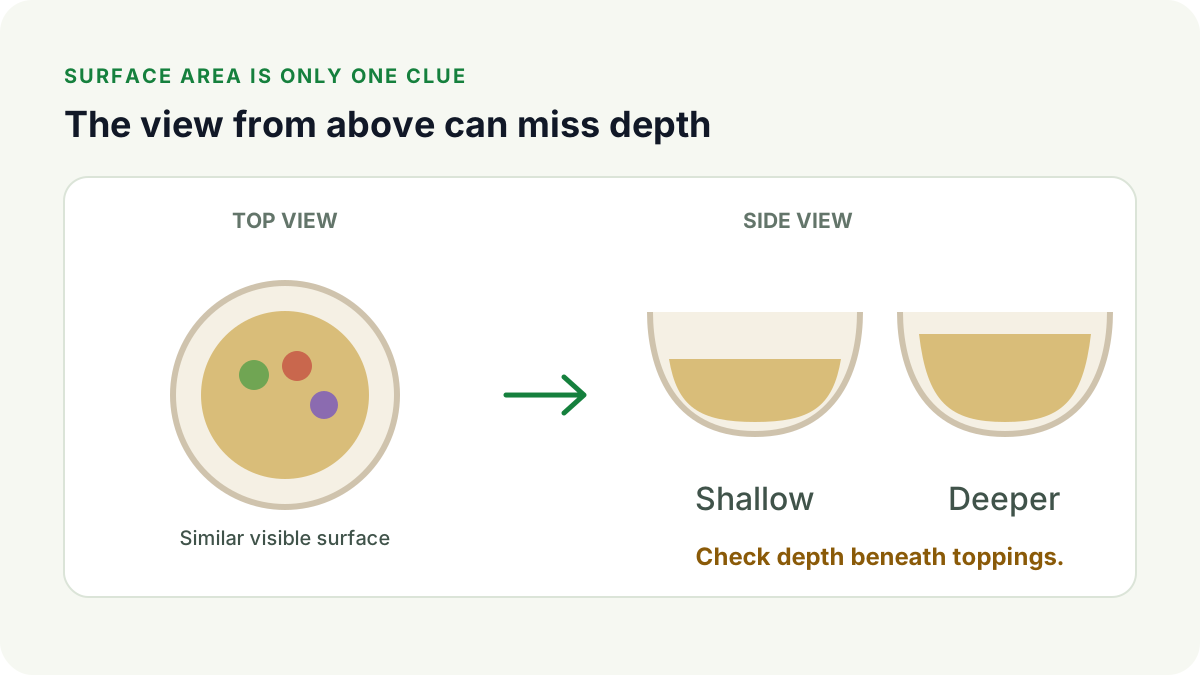
Those differences mean a visual reference works best within a familiar context. “This much of this food in this bowl” is a stronger reference than “all foods the size of my fist.”
Build your own calibration routine
Choose one or two foods that you eat frequently and find difficult to judge. Rice, cereal, pasta, nuts, and spreads are practical candidates because portions can change without being obvious.
- Serve your normal amount rather than deliberately changing it.
- Measure using a suitable cup, spoon, known package portion, or scale.
- Note the food’s state: raw, cooked, drained, chopped, or packed.
- Look at the portion in the dish you normally use.
- Save a reference photograph or a short note for yourself.
This is calibration, not proof that every future portion is identical. Repeat the exercise when you change bowls, use a different preparation, or notice that your reference no longer matches.
Use the right tool for the question
| Reference | Useful for | Main limitation |
|---|---|---|
| Labeled pieces or container | Packaged foods with clear units | Unit size and servings still matter |
| Level measuring cup | Foods with matching volume guidance | Packing and heaping change the amount |
| Familiar bowl or spoon | Repeat meals in the same setting | Different food density or depth |
| Hand comparison | Rough planning away from home | No universal conversion to grams |
| Kitchen scale | Checking ingredient mass | Requires a matching food-state entry |
A scale improves knowledge of mass, not knowledge of the recipe. Weighing a restaurant curry does not tell you how much oil or coconut milk it contains. Different tools solve different uncertainties.
Separate raw and cooked amounts
Suppose a recipe starts with dry rice and water. The cooked rice becomes heavier as it absorbs water, but the water does not add calories. A cooked portion therefore has a different energy concentration by weight than the dry ingredient.
The same principle works differently for foods that lose water. Cooked meat may weigh less than it did raw. Matching the preparation state is important whether you are using a label, recipe calculation, or USDA composition entry.
For a shared recipe, track the total ingredients and divide by the actual yield or portions. Equal-looking servings may still contain different amounts of meat, vegetables, or sauce if the dish is not mixed evenly.
Pay attention to concentrated additions
Oil, nut butter, dressings, cheese, and seeds can be difficult to judge from a glance. A heaped spoon is not the same as a level spoon, and an unmeasured pour may vary substantially from meal to meal.
Measure a typical spoonful once if it helps you understand your normal use. Do not turn this into a rule that these foods should be avoided. Nuts and oils can contribute useful nutrients; the point is to understand the amount when estimating energy.
For a manageable routine, see calorie tracking without weighing every food. Prioritizing the largest uncertainties is often more practical than measuring every low-impact detail.
What can a meal photo add?
A photograph records the visible portion and can help you compare repeat meals. Include the whole plate, not just the most appealing close-up. If depth is hard to judge, use what you know about the bowl rather than assuming the image resolves it.
MeasureFood offers photo-based calorie and macro estimates. A useful check is whether the assumed portion matches your calibrated reference, especially for foods hidden underneath toppings.
You can try a scan of a familiar meal, then compare it with the amount you know. That comparison is a learning exercise, not an independent validation of the app across every food.
Estimating portions at restaurants
Start with the menu description and any available nutrition information for the specific item. Notice whether a dish is intended for sharing, whether a sauce is separate, and how much of the original portion you actually eat.
If the plate is unfamiliar, make a broad component-based estimate rather than attaching false precision. The amount of rice, protein, and sauce may each carry uncertainty. Acknowledge that instead of treating one generic database serving as the answer.
Leftovers and second helpings matter too. A photograph taken before the meal represents what was served, not automatically what you consumed. Your own observations remain relevant after the camera has done its job.
Portion awareness does not require restriction
Learning portion sizes is about understanding food, not proving that smaller is always better. Adequate intake depends on individual needs, activity, health, and appetite. Some people need more energy, and others need specific clinical guidance.
Harvard’s Healthy Eating Plate offers approximate food-group proportions as one planning approach. Those proportions are not an exact calorie allocation. You can use a balanced-meal framework without calculating every gram.
If you want to connect portions with protein, carbohydrate, and fat, read our beginner macro-tracking guide. Keep that learning goal separate from rigid targets copied from someone else.
A practical next step
Choose one familiar food this week, establish a clear reference, and learn its limitations. That is more useful than memorizing ten supposedly exact hand rules. Use careful measurement when it matters, and accept reasonable uncertainty when it does not.
The strongest routine combines convenient technology with your knowledge of what was actually on the plate.
Frequently asked questions
Is one palm of food always the same weight?
No. Hand size, food thickness, density, and preparation differ. A palm can be a rough reference, not a fixed gram value.
Does a smaller plate guarantee a smaller portion?
No. Plate size can change visual perception, but depth, stacking, and refills still determine the actual amount.
Should I weigh rice before or after cooking?
Either can work if the database entry matches the state you measured. Dry rice and cooked rice have different water content, so do not mix the two references.
References
This article is general education, not medical advice. MeasureFood values are estimates. Read our editorial policy.


