
How to Track Macros: A Practical Beginner's Guide
Learn how to track macros without losing sight of food quality. Understand protein, carbs, fat, labels, portions, and the limits of photo estimates.

Quick answer
To track macros, record the protein, carbohydrate, and fat in the amount you actually eat. Start with matching nutrition labels or ingredient data, check serving sizes, and review your meals as a pattern rather than chasing perfect daily numbers. Photo estimates can simplify the first pass, but portions and hidden ingredients still need checking. Individual macro targets depend on personal needs.
Key takeaways
- Most foods contain a mixture of macros, not just one.
- Serving size matters as much as the nutrient numbers.
- A macro total does not capture fiber, variety, or overall food quality.
- Personal targets require context; one popular ratio does not suit everyone.
- ProteinBuilding blocks; found in beans, tofu, eggs, fish, and more.
- CarbohydrateFuel, plus fiber in foods such as grains and legumes.
- FatEnergy and essential functions; consider the food source.
Learning how to track macros can make meal planning less mysterious. Instead of seeing only a calorie number, you notice the protein, carbohydrate, and fat that make up your meals. That can help you ask more useful questions about what you eat.
It can also become needlessly complicated. Beginners often jump straight to a strict ratio before understanding serving sizes or how mixed foods work. Start with a reliable record of ordinary meals, then decide whether a more detailed target would actually help.
What are macros?
“Macros” is shorthand for macronutrients. In everyday food tracking, the term usually refers to protein, carbohydrates, and fat. These nutrients supply energy, but they also have functions beyond their calorie contribution.
Protein supplies amino acids used throughout the body. Carbohydrates include sugars, starches, and fiber; their food sources differ considerably. Fat supports essential functions and contributes energy, with the type and source of fat relevant to overall dietary quality.
| Macro | Common food sources | Important context |
|---|---|---|
| Protein | Fish, eggs, tofu, beans, yogurt | Sources also differ in fiber, fats, and sodium |
| Carbohydrate | Rice, oats, fruit, lentils, bread | Whole-food sources can contribute fiber and micronutrients |
| Fat | Oils, nuts, seeds, avocado | Small portions can contribute meaningful energy |
Most foods are not a single macro. Beans provide carbohydrate and protein. Nuts provide fat and protein. Yogurt can supply protein, carbohydrate, and fat depending on the product. Avoid forcing every ingredient into only one box.
Step 1: Decide why you want to track
Choose a concrete learning goal before selecting a target. You might want to see whether lunch contains a meaningful protein source, understand why snacks are not satisfying, or compare the composition of your usual breakfasts.
Those goals require less precision than a clinical nutrition plan. They also make it easier to stop tracking when you have learned what you needed. A food log should support your decisions, not become an obligation disconnected from your health.
If tracking increases anxiety, guilt, restriction, or preoccupation with food, consider a nonnumeric approach and professional support. Numerical tracking is not necessary for everyone and is not a substitute for care.
Step 2: Record the amount actually eaten
A nutrition label’s macro values apply to its stated serving. If you eat two servings, the listed amounts need to be doubled. If you eat half, the amounts need to be halved. Check the serving unit before copying any number.
For homemade meals, use ingredient quantities and the number of portions the recipe actually produced. Match raw ingredients with raw-food entries, or cooked portions with suitable cooked-food entries. Cooking changes water content, so equal weights do not necessarily represent equivalent amounts.
When weighing every ingredient is unrealistic, use a consistent practical method. Our guide to calorie tracking without weighing food explains how to prioritize labels, familiar portions, and the largest unknowns.
Step 3: Understand grams versus calories
Macro amounts are commonly recorded in grams. Energy is recorded in calories. The conventional approximate energy factors are four calories per gram for protein, four for carbohydrate, and nine for fat.
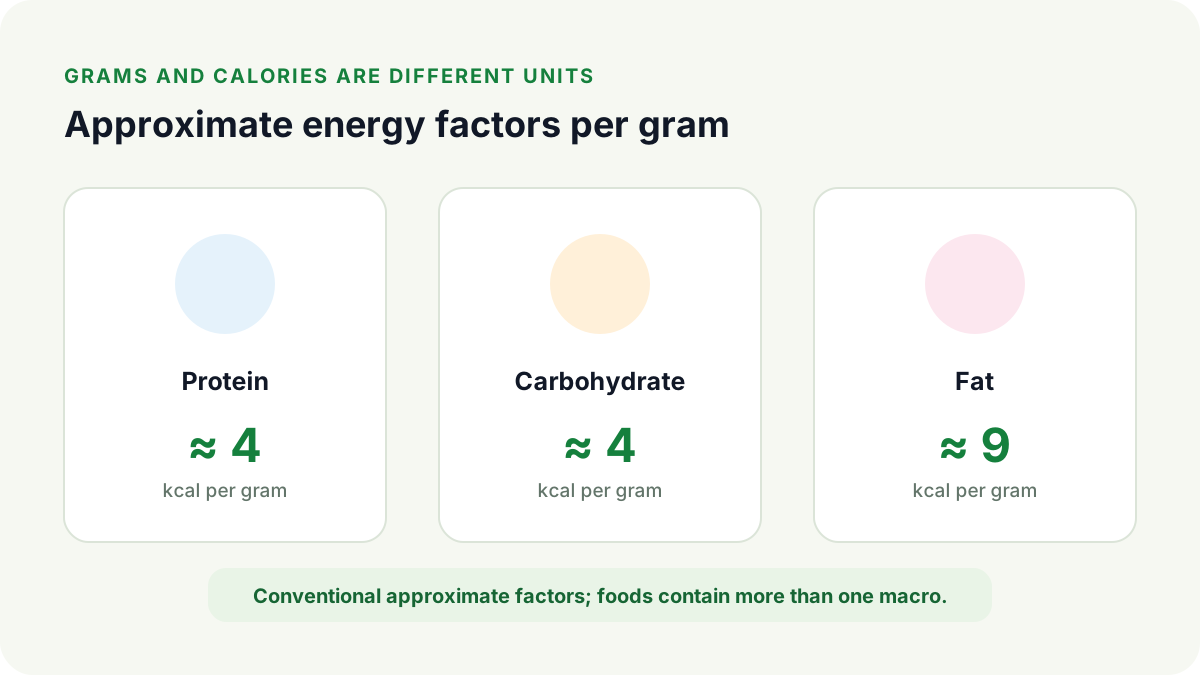
For a purely illustrative arithmetic example, a meal recorded as 25 grams of protein, 50 grams of carbohydrate, and 15 grams of fat would calculate to about 435 calories using those factors. This is a demonstration of the calculation, not the measured content of a photographed meal.
Actual label totals may not exactly match simple arithmetic because of rounding, fiber, sugar alcohols, and permitted calculation methods. Do not assume a small mismatch means the label is fraudulent or that you should repeatedly edit a record until everything fits perfectly.
Step 4: Check the whole meal
Look beyond the obvious protein or starch. A stir-fry may include rice, tofu, vegetables, cooking oil, and a sweetened sauce. The oil and sauce can be easy to miss because they are distributed through the dish.
Use the same review order each time: identify the main ingredients, check preparation, estimate the amount, then consider additions. This is more useful than focusing on tiny differences between nearly identical database entries.
For visual references, see how to estimate portion sizes. Calibrating your usual bowl or spoon once can provide context that remains useful when you are away from a kitchen scale.
Step 5: Review patterns before making changes
A few ordinary days can reveal patterns worth discussing or adjusting. Perhaps breakfast regularly lacks a protein source, vegetables rarely appear at lunch, or a drink contributes more energy than you realized.
Do not interpret a single day’s totals as a diagnosis. Hunger, activity, schedule, appetite, and food availability vary. Look for recurring issues rather than treating each deviation as something that must be corrected at the next meal.
Useful review questions include:
- Are meals regular enough to support my day?
- Do I include varied sources of protein?
- Are carbohydrate sources contributing fiber?
- Am I considering the foods that accompany the macros?
- Is the routine manageable without excessive effort?
Macro quality still matters
Two meals can have similar macro totals but differ in fiber, sodium, vitamins, minerals, and food variety. Harvard’s Nutrition Source emphasizes the protein “package”: the other components that come with a protein source are relevant, not just its protein grams.
Likewise, carbohydrate quality matters. Lentils, oats, fruit, and sugary drinks do not become nutritionally interchangeable because some of their carbohydrate grams match. Tracking is a limited view, not a complete measure of dietary quality.
Our explanation of nutrient density versus calorie density helps connect energy numbers with the nutrients a food contributes. It is possible for an energy-dense food, such as nuts, to also provide useful nutrients.
Can a food-photo scanner help?
MeasureFood provides estimated calories and macros from meal photos, as well as label scanning and food-quality insights. A photo-first workflow can lower the effort of getting an initial overview.
The estimate still depends on food identification and portions. Hidden oil, fillings, or an incorrect recipe assumption can affect the macro breakdown, just as they affect calories. There is no basis here for promising exact protein or carbohydrate grams from an image.
You can scan a familiar meal with MeasureFood, compare the interpretation with your recipe, and use that comparison to learn which details deserve attention.
When do you need individualized targets?
Specific requirements can change with age, pregnancy, training, medical conditions, medications, and other factors. A ratio copied from a fitness influencer may not match your needs, and a general app estimate cannot assess those factors comprehensively.
If you need a prescribed plan, work with a qualified healthcare professional or registered dietitian. Otherwise, begin with understanding meals rather than optimizing a spreadsheet. Keep food quality and your relationship with eating in view.
Frequently asked questions
Do I have to track macros to eat well?
No. Regular meals, food variety, and balanced portions can be useful without numerical tracking. Tracking is an optional learning tool.
Is there one ideal macro ratio?
No. Appropriate amounts vary with age, activity, health conditions, dietary preferences, and goals. A registered dietitian can help when specific targets are needed.
Should I count total carbs or net carbs?
Know which convention your plan uses. US Nutrition Facts lists total carbohydrate, including fiber. Do not switch conventions within the same record or use app estimates for medication dosing.
References
- Merck Manual: Carbohydrates, Proteins, and Fats (opens in a new tab)
- Harvard Nutrition Source: Protein (opens in a new tab)
- Harvard Nutrition Source: Carbohydrates (opens in a new tab)
- FDA: How to Understand and Use the Nutrition Facts Label (opens in a new tab)
- Harvard Healthy Eating Plate (opens in a new tab)
This article is general education, not medical advice. MeasureFood values are estimates. Read our editorial policy.


