
How Accurate Are AI Calorie Counters? What to Check
How accurate are AI calorie counters? Understand photo estimation errors, what research can tell you, and simple checks that make results more useful.

Quick answer
There is no reliable accuracy percentage that applies to every AI calorie counter. Results vary with the app, meal, portion size, preparation, and testing method. Photos cannot directly measure weight or reveal hidden fats. Treat estimates as a convenient starting point, check important assumptions against labels or recipes, and use validated methods when precise nutrition information is medically necessary.
Key takeaways
- A food-recognition percentage is not a calorie-accuracy percentage.
- Portion depth and hidden fats can matter more than image sharpness.
- Research on general-purpose models does not validate a commercial app.
- Check a few familiar meals instead of assuming every result is exact.
- IdentityA breaded cutlet is not plain chicken.
- AmountA photo shows area more easily than depth.
- RecipeOil and fillings may be invisible.
How accurate are AI calorie counters when the meal in front of you is not a neatly labeled test plate? The honest answer is that accuracy depends on the system and the meal. A photo can make logging easier without making every calorie estimate dependable.
That is not a reason to dismiss the technology. It is a reason to ask better questions. Instead of looking for one reassuring percentage, examine what was measured, which mistakes are likely, and whether the estimate is useful for your purpose.
First, define what “accurate” means
An app might identify a food correctly while estimating its energy poorly. If it recognizes a bowl of pasta but assumes the wrong amount or sauce, recognition succeeded while the calorie estimate did not.
Several different metrics can appear in marketing or research:
| Claim or metric | What it describes | What it does not prove |
|---|---|---|
| Recognition accuracy | Correct food categories | Correct food weight or calories |
| Average calorie error | Difference from reference energy values | Small error for every meal |
| Correlation | Whether estimates rise with reference values | Agreement at the same numeric value |
| Repeatability | Similar output on repeated input | That the repeated estimate is correct |
A percentage without a method is difficult to interpret. Ask whether it measures food names, portion weights, energy, or the final corrected food log. Those are not interchangeable outcomes.
Why can photo estimates miss?
Portion size is not visible weight
Two similar-looking bowls can hold different amounts of rice because of bowl depth or how tightly the food is packed. A top-down photograph captures surface area, but food volume also depends on height. Even a good volume estimate still requires assumptions about density.
This is why learning to calibrate portion sizes can be more valuable than repeatedly taking the same photograph. Familiar dishes and occasional measurements provide context that a single image lacks.
Recipes hide important information
Oil, butter, cream, sugar, and nut pastes can blend into a dish. A sauce’s appearance does not reliably reveal its recipe. A smoothie can contain fruit and water, or fruit, milk, yogurt, oats, and nut butter, while looking broadly similar.
Cooking also changes weight through water loss or absorption. Choosing a raw-food entry for a cooked portion can create a mismatch even if the food itself was recognized correctly.
The reference data may not match
USDA FoodData Central contains multiple types of food-composition data, including basic foods, survey foods, and branded products. Different entries answer different questions. A generic curry is not necessarily your restaurant’s curry, and a branded product can change formulation.
The practical issue is not whether a database is large. It is whether the selected information represents what was actually eaten, prepared in a comparable way, in the correct amount.
What does published research tell us?
A 2025 study published in Current Developments in Nutrition evaluated three general-purpose language models using 52 standardized photographs. The researchers compared estimates with directly weighed food and nutrition-database reference values. The photographs included individual components and meals in different portion sizes.
The study found substantial error and differences between models. It also reported systematic underestimation that increased with portion size. That supports caution about treating a food image as a precise measurement.
However, its scope is essential: it tested particular versions of general-purpose models, not every commercial scanner and not MeasureFood. It cannot establish the current accuracy of an app with a different model, workflow, database, or correction process.
Avoid turning one study into a universal verdict. Equally, avoid using a vendor’s best-case demonstration as proof of performance across unfamiliar cuisines, mixed dishes, restaurant meals, and large portions.
How to read an app’s accuracy claim
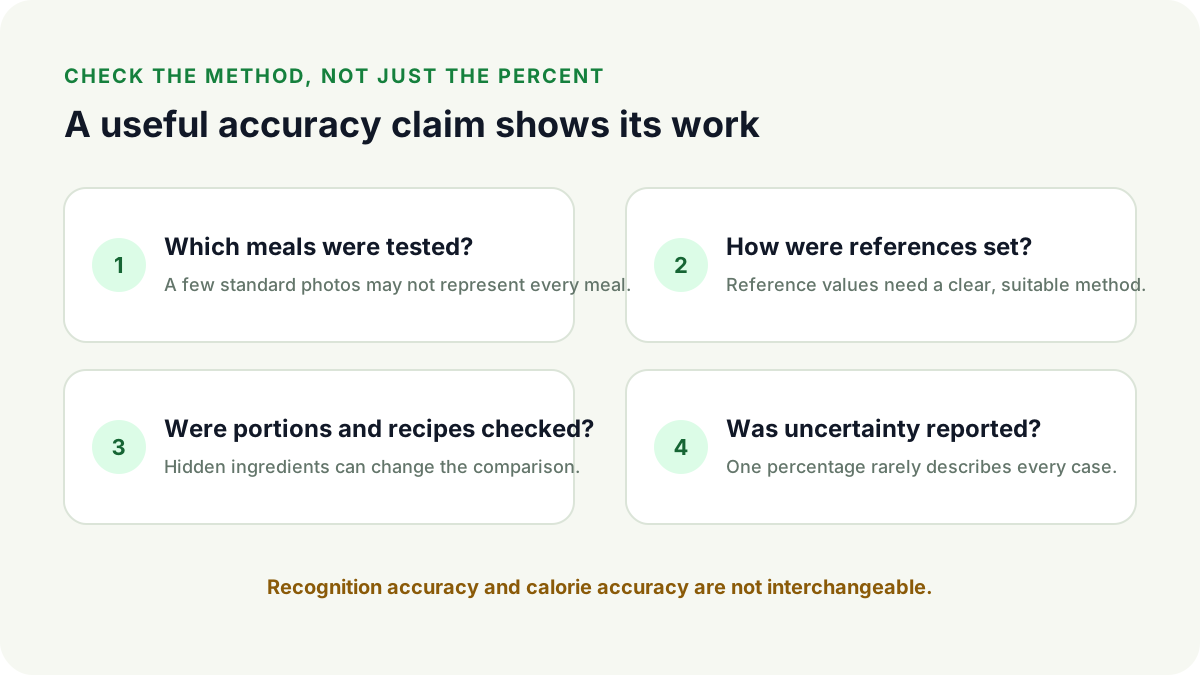
Look for answers to these questions before trusting a headline:
- What exactly was tested: recognition, calories, or macros?
- How many meals were included, and how varied were they?
- Were portions weighed and recipes known?
- Was performance reported before or after user corrections?
- Were difficult meals included, or only simple visible ingredients?
- Who ran the test, and can the method be inspected?
No single checklist item proves quality. Together, they reveal whether a claim contains useful evidence or mainly serves as a sales message. Independent validation is especially relevant when the claimed use requires precision.
A practical check using meals you know
Choose several meals for which you have reliable ingredient amounts or a clear packaged-food label. Include a simple plate and a mixed dish, rather than selecting only foods that are easy to identify.
Scan each meal under normal conditions. Record the initial estimate, then compare it with the best available reference. Check food identity, preparation, portion, and additions separately. This is a personal spot-check, not a scientific validation study.
The most useful outcome is finding your recurring error pattern. Perhaps your usual rice bowl is consistently interpreted as smaller, or your dressing is missed. That tells you what to review on future scans without assuming the same correction applies to every food.
Does manual logging solve the problem?
Manual logging can improve accuracy when you have weighed ingredients and select matching entries. It can also go wrong when you choose an arbitrary serving, omit cooking fat, or copy an unrelated restaurant listing.
Think of logging methods as different ways of gathering evidence. A meal photograph is convenient; a label gives product-specific information; a measured recipe gives ingredient detail. Combine them according to what you actually know.
Our AI food scanner overview explains these inputs, while the photo calorie estimation guide provides a capture-and-review routine for everyday meals.
Where does MeasureFood fit?
MeasureFood provides photo-based calorie and macro estimates alongside food-quality insights. We do not publish a measured accuracy percentage because the public materials reviewed did not include an independent validation protocol.
You can try a familiar meal in MeasureFood and review its interpretation against your recipe or label. Use the result to understand the workflow, not to claim that a few successful scans establish accuracy for all meals.
Match precision to the decision
For general food awareness, a rough but understandable estimate may be useful. For insulin dosing, allergies, kidney-related restrictions, or other clinical decisions, photo estimates alone are not adequate. Follow your clinician’s prescribed measurement approach.
The goal is not to distrust every number. It is to avoid giving a number more authority than its evidence deserves. Keep the convenience, check the assumptions, and use stronger information whenever the consequences of error are important.
Frequently asked questions
Does a clearer photo guarantee an accurate calorie count?
No. Good lighting helps recognition, but a sharp photo still cannot reveal the full recipe, food weight, or oil absorbed during cooking.
Are manual food logs always more accurate?
No. Manual logs can use the wrong food entry or portion. Measured ingredients and a matching database improve the evidence, but simply typing a food name does not guarantee accuracy.
Has MeasureFood been independently validated?
The public product pages reviewed for this article did not provide an independent validation study. We do not assign MeasureFood a measured accuracy rate.
References
This article is general education, not medical advice. MeasureFood values are estimates. Read our editorial policy.


